DevOps is a process that truly leverages and synthesizes automation and cloud adoption. It ensures rapid on-boarding of applications by automating end-to-end delivery pipeline and facilitating continuous integration and development across leading cloud platforms. DevOps also accelerate cloud operations and workloads by minimizing costs, increasing efficiency, enabling agile development, and speeding up the release management cycle.
Why DevOps for our customers
Our Enterprise DevOps consulting services help organizations achieve higher efficiency in Development and Operations, quicker time to market, rapid delivery, reliable and better quality of software builds. With early identification of emerging development issues, always let the code be in a releasable state with minimal effort and automating the process. And incorporating all DevOps capabilities and cultures: collaboration, automation, continuous integration, continuous delivery, continuous testing, monitoring, and rapid remediation.
DevOps benefits your organization in many ways:
- Increased efficiency among IT groups
- faster development and deployment
- Automation of build and deployments
- Faster go to the market for software
- Quick feedback implements
- No downtime of deployment
- Improvement to the whole software delivery pipeline and practices through builds, validations, and deployment
- Modernized development processes through increased responsibility and code ownership
Why Cloud Kinetics for DevOps
Our DevOps solutions help customers align with the goals fast and reliably, and streamline the development and operations processes to achieve a faster time to market.
- Specialized DevOps Center of Excellence
- Large multi-cloud customer references in Asia
- Centralized, shared services model offers better value
- DevOps compliance policies, fine-grained controls, and configuration management
- Usage of infrastructure as code and policy as code
Cloud Kinetics’ DevOps approach
CK’s DevOps approach orchestrates all DevOps tools, CI/CD processes, automates infrastructure, and streamlines operations, facilitating Infra/Dev/Ops/QA/Security communication. And practices that need to accelerate software delivery.
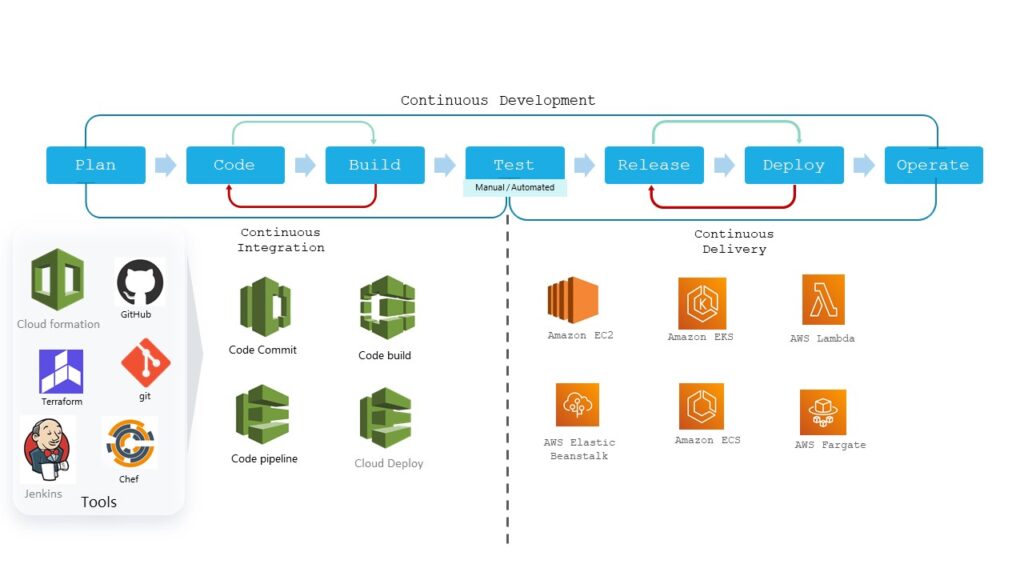
CI/CD Tools Canvas
DevOps is a method of build and deploying applications, it requires the right IT team and right tools to create. Generally, for the DevOps practice, we rely on the CI/CD pipelines, containers, and cloud-native tools. And can be extended to open source, proprietary, or supported distributions of open source technology.
Code repository – Code repositories enable multiple developers to work on code coupled with version control enabled. Tools used for source code management include AWS CodeCommit, and opensource tools such as Git and GitHub.
CI/CD pipelines – The continuous integration tool initializes CI-CD processes to create, test, and validate code in a shared repository. Mostly automating the manual work. Tools used for CI/CD pipelines include AWS CodePipeline and opensource tools such as Jenkins.
Continuous delivery – extends the automatic steps through production-level tests and configuration setups for release management. Tools used for continuous delivery include a combination of AWS CodePipeline & AWS CodeBuild and opensource tools such as Jenkins.
Continuous Deployment – Invoking tests, configuration, and provisioning, as well as monitoring and potential rollback capabilities. Tools used for continuous delivery include AWS CodeDeploy and opensource tools such as GitLab, Chef, and CircleCI.